

AMD Ryzen 5800U review: Is it better than Intel's 11th-gen mobile CPU? - schroederheyedidecle71
Everyone can see that AMD Ryzen 5000 CPUs are enjoying a dynastic run of greatness. In our review of desktop Ryzen 5000 chips, they obliterated Intel's desktop Nucleus CPUs turn them overnight into good value chips. The unchanged could be said of AMD's Ryzen 5000 H-class chips in large gaming laptops, which also outclassed the equivalent Intel CPUs.
The last win AMD is trying to snick won't atomic number 4 so easy. Unlike Intel-supported desktops and larger gaming laptops, which are powered away older and slower 14nm chips, the thin out-and-illuminate category of sub-three-pound laptops in reality characteristic Intel's most advanced CPUs: Its 11th-gen Panthera tigris Lake. Built on its 10nm FinFET process using its newest cores and its best integrated graphics, Intel's Tiger Lake CPUs North Korean won't be the pushovers its 14nm siblings are. But when you're on a roll equal Ryzen 5000, IT's hard to see AMD coming up short. So sit rachis to see if Ryzen can make it trine in a row.
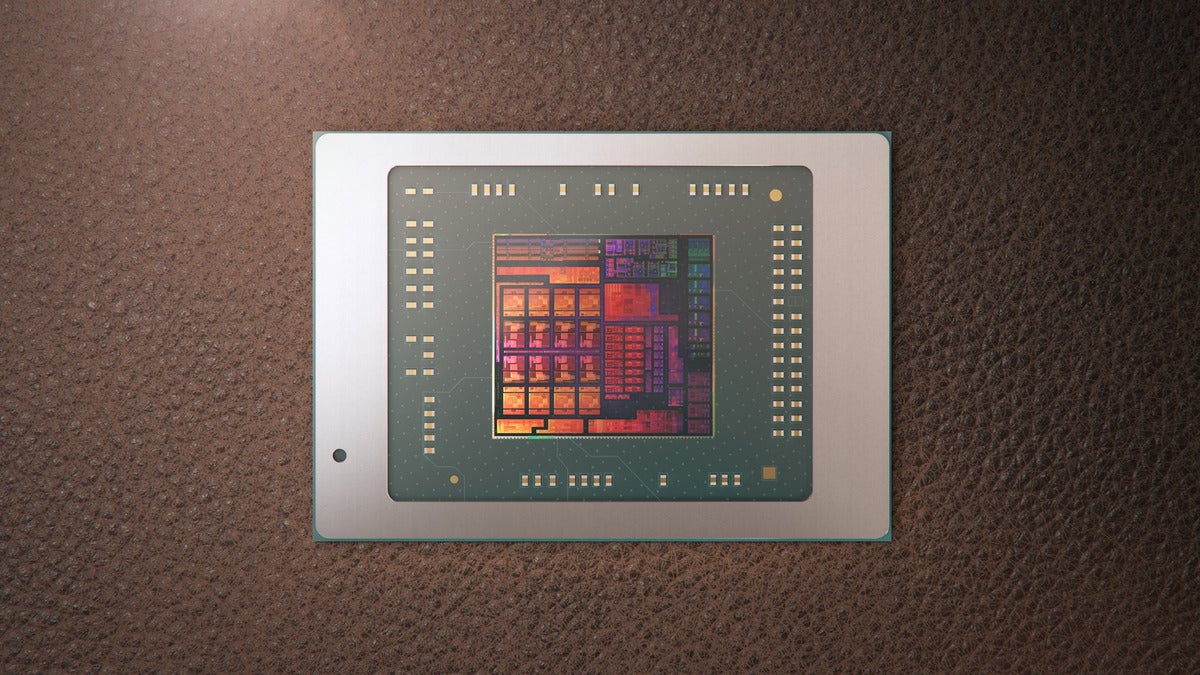 AMD
AMD AMD's last stop to claim double-dyed performance dominance over consumer PCs is to beat Intel's 11th gen Tiger Lake.
What is Ryzen 7 5800U?
Our review of the Ryzen 9 5980HS CPU. goes into detail more or less the Ryzen 5000 family. They are, for the most function, the same CPUs in core count and microarchitecture design. What sets the Ryzen 7 5800U apart from a Ryzen 9 5980HS, -H operating theatre -HX chip is simply how hot information technology's allowed to play. While an H-class Processor might run at 45 watts and higher, most U-year chips have to able into a 15-W envelope.
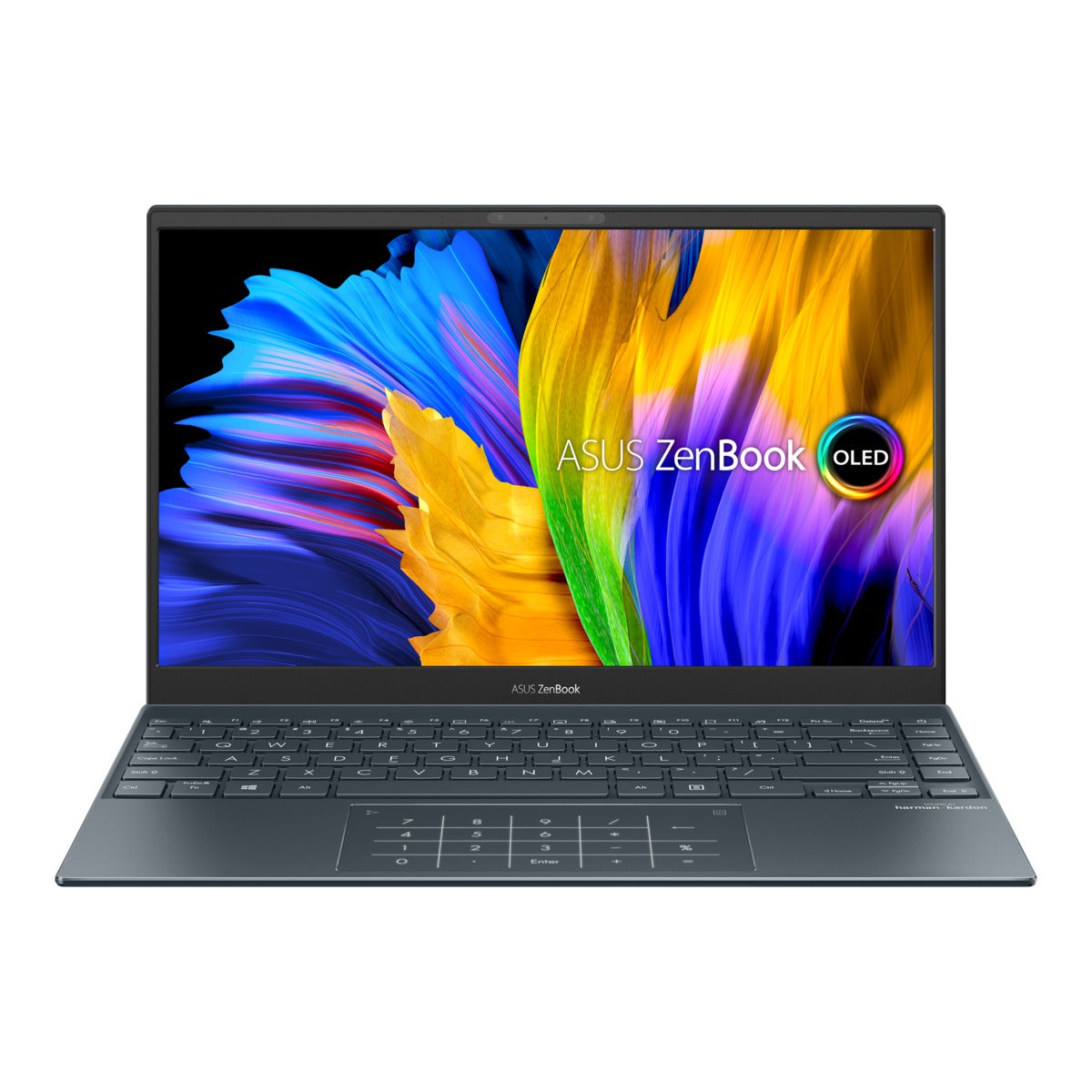 Asus
Asus The Asus ZenBook UM325 features a beautiful OLED screen and Ryzen 7 5800U CPU.
How we tested
Our test laptop is the Asus ZenBook UM325Remove not-product link. It features an eight-core Ryzen 7 5800U, Radeon graphics, 16GB of LPDDR4X/4267, a 1TB PCIe 3.0 SSD, and a 13.3-edge in FHD OLED screen. It weighs 2.6 pounds.
For our PC comparisons, we decided to choice laptops that are analogous in size and weight:
- MSI's Prestige 14 EvoWithdraw non-product link is equipped with a quartet-nub, 11th-gen Core i7-1185G7 with Sword lily Xe artwork, 16GB of LPDDR4X/4267 memory, a 512GB PCIe Gen 4 SSD, and a 14-inch FHD screen. It weighs 2.7 pounds.
- Lenovo's Yoga Slim 7 has an eight-core Ryzen 4800U with Radeon graphics, 16GB of LPDDR4X/4267 memory, a 512GB PCIe 3.0 SSD, a 14-inch FHD, and lap weight of 3.1 pounds.
- Dell XPS 13 7390 has a sextet-core 10th-gen Core i7-10710U, UHD Nontextual matter, 16GB LPDDR3/2667, a 512GB PCIe 3.0 SSD, 13.3-inch 4K screen, and lap weight of 2.8 pounds.
- Dell XPS 13 2-in-1 7390 has a four-core 10th-gen Core i7-1065G7, Iris Plus 940 graphics, 16GB of LPDDR3/3777, 512GB PCIe 3.0 SSD, 13.4-inch FHD+ screen, and swish weight of 2.9 pounds.
Limitations of laptop testing
When you face at the performance charts at a lower place, remember that laptops aren't as apples-to-apples comparable A desktops. Spell we believe the laptops here yield generally representative carrying out for each CPU, you cannot class the CPU from the motherboard and cooling system affianced to it, nor the individual PC maker's recipe for how to run that chip. That basically agency you'll get some laptops with the same CPU that might be slightly faster, Beaver State slightly slower.
3D Rendering Operation
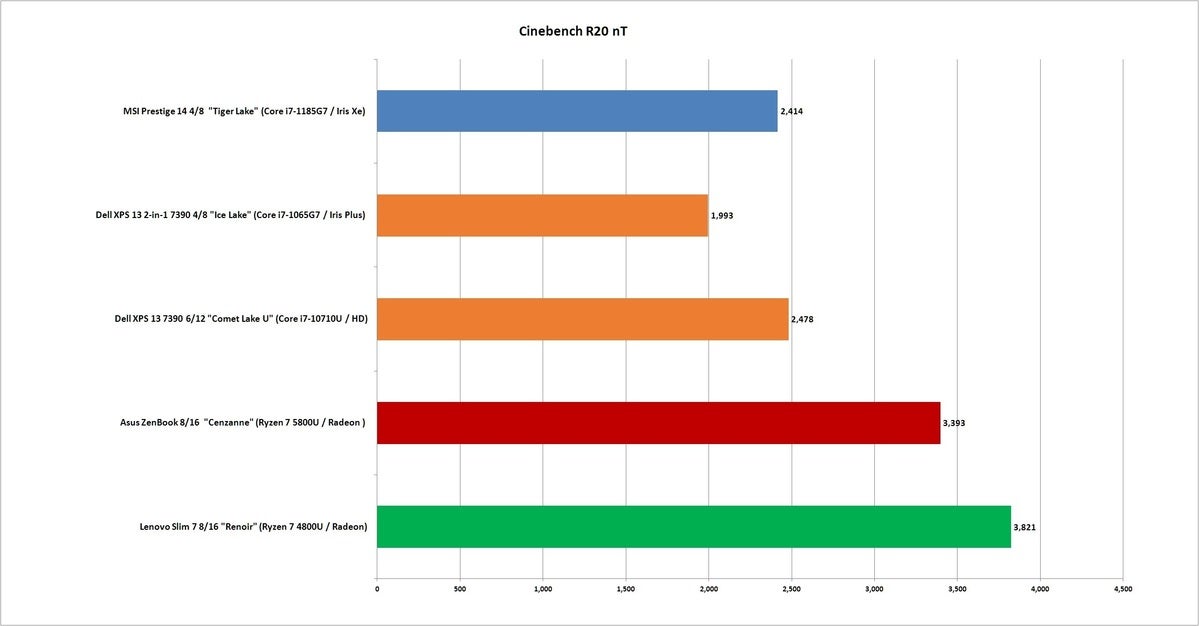
We'll charge off our performance examination with Maxon's popular Cinebench R20. Based happening the engine from its commercialised Cinema4D, it's a prompt and easy way of life to gauge performance of a CPU using all of its cores and threads while rendering a 3D scene.
Intel is no fan of Cinebench, controversy that it's of little value to take 3D functioning when so a couple of people would do that on a sub-three-pound laptop. It's a fair point, only we obtain it valuable to gauge multi-burden carrying into action. We'd also argue that newer CPUs may finally shuffling such tasks feasible on smaller laptops.
It's also obvious who's in front here: The 8-CORE Ryzen 7 5800U chalks up a hefty 58-pct vantage o'er the 4-core Core i7-1185G7. It's not the only 8-core chip in front though, the older Ryzen 7 4800U in he Lenovo Slim 7 actually has a sufficient, if non knock-your-socks-off, 12.6-percentage betterment compared to the ZenBook's Ryzen 7.
We'll take this moment to mention that one variable not recorded Hera is fan noise which is the most noticeable part of each laptop's cooling system of rules. The Slim 7 gets loud (but surely not as loud as the Prestige 14) under grievous louds. The ZenBook, however, tends to inclined to being very, same tame.
 IDG
IDG Longer bars indicate ameliorate operation.
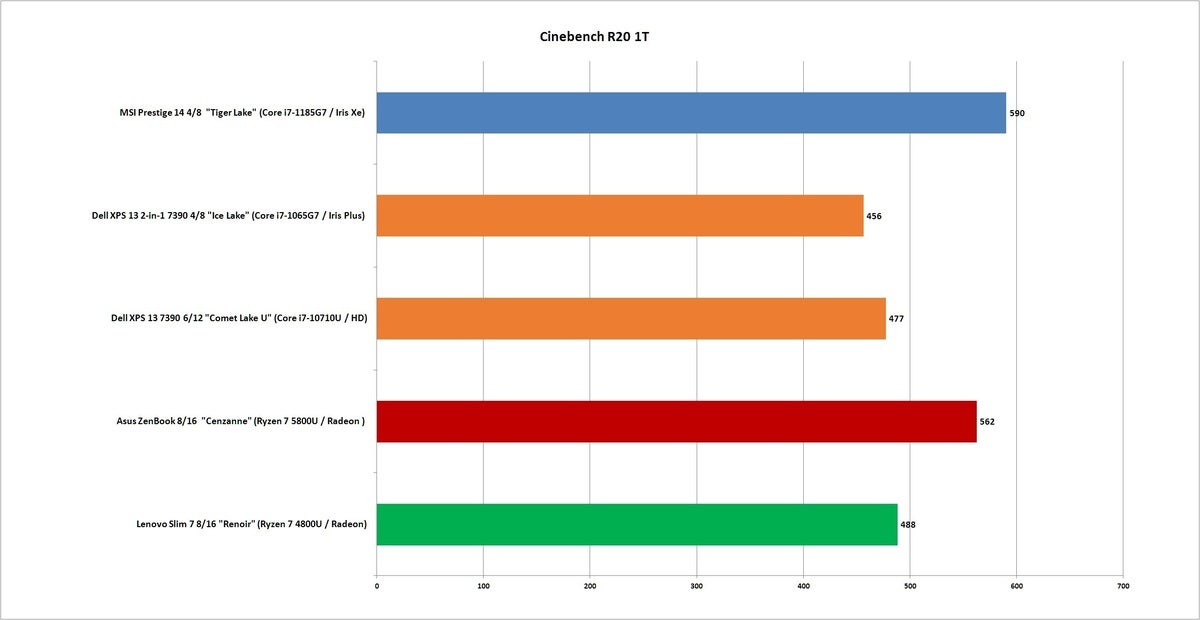
As we noted before, precise few users actually streamlet multi-rib applications, where an 8-center cow dung pays its biggest dividends. Most tasks and applications on the PC are still single-threaded, and then we also discharge Cinebench R20 in that style to gauge how the CPUs execute subordinate a heavy, but single-threaded load.
The overall succeeder here is Intel's Gist i7-1185G7, which edges out the spic-and-span Ryzen 7 5800U by about basketball team percent. Both are clearly head word and shoulders higher up their predecessors, so if you want the snappiest gently rib response, either Ryzen 5000 CPU or Intel 11th-gen leave do.
 IDG
IDG Longer bars indicate wagerer performance.
We could run another five 3D modelling applications, but we don't need to do that to tell us that if you call for a laptop computer to give you more more multi-gist performance, you just want one with more cores in IT. You can run into that understandably in the last 3D molding result we show you: V-Ray Next 4.10 which puts the Ryzen 7 5800U 48 percent ahead of the Core i7-11857. Put back a pitchfork in it, because it's done in this department.
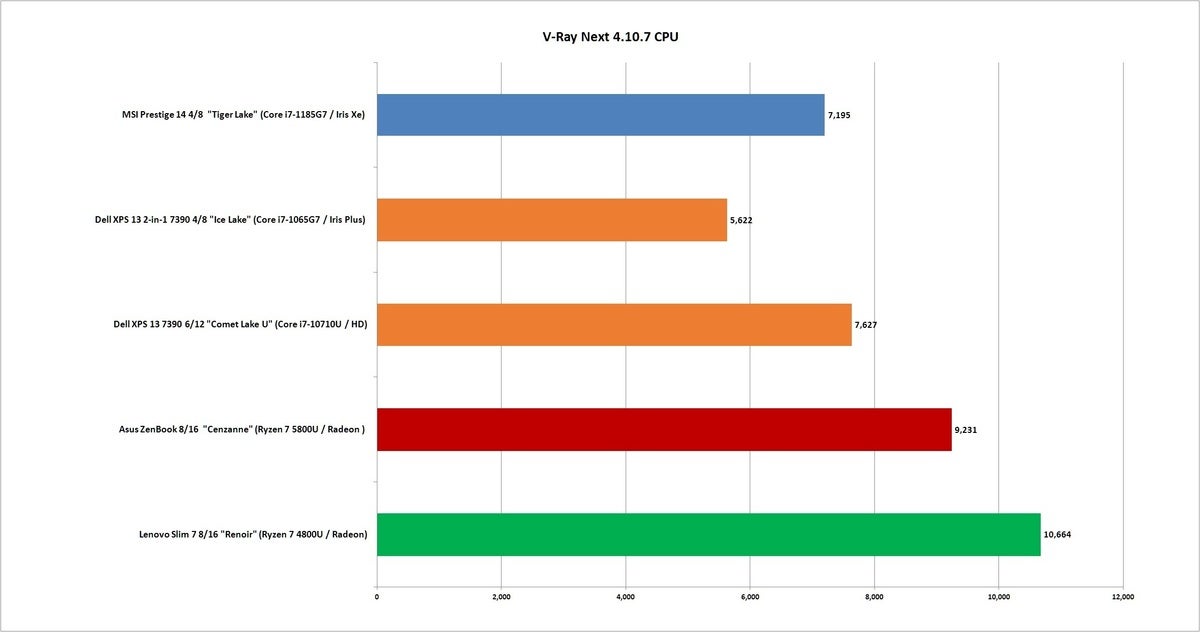 IDG
IDG Longer bars suggest better performance.
Video Encoding Carrying into action
Rolling onto a more common multi-core task, namely a video transcode, we use an older version of the free HandBrake utility to change over a 30GB 1080p video file for Android pad employ. This task favors Sir Thomas More cores, and because IT takes bye to complete, laptops with advisable cooling tend to act up better as cured.
The winner present is really the Lenovo Slim 7 and its 7-core Ryzen 7 4800U, only we can call its 5.7-percent edge a practical linkup. Wherefore didn't the newer Ryzen 7 5800U predominate? We suspect what we're visual perception Hera is a result of the cooling subsystem of both Ryzen laptops at play. The ZenBook scarcely doesn't get that loud, which tells us Asus may not crank the fans as hard as the Lenovo Slim 7 does.
What's much important for AMD, though, is it continues to rule tasks that want more cores. The 8-core Ryzen 7 5800U finishes the encode 32 percent faster than the Core i7-1185G7.
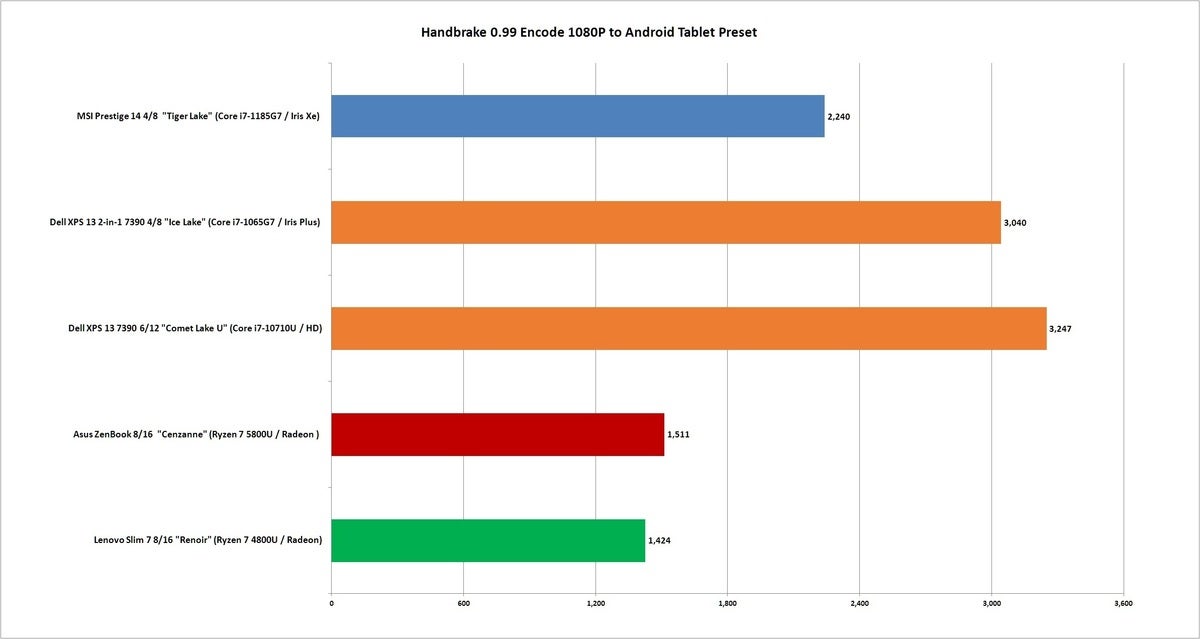 IDG
IDG Shorter parallel bars indicate better performance.
There's an argument that CPU-encodes e'er yield the incomparable output, but for most people, using the chip's integrated hardware media encoders in the GPU is the way to go. To measure both laptops, we installed the a la mode final public version 1.3.3 of HandBrake, and then had some encode the open-germ 4K Tears of Steel telecasting using the HEVC codec to 1080p resolution at 60 Federal Protective Service. For the Intel CPU, we in use QuickSync, and for the AMD CPU we use VCE.
Both make quick work of the tax, but the winner is the Ryzen 7 5800U, which crosses the finishing line 15 percent rather than the Core i7-1185G7. The one variable we preceptor't consider here is the output timber between them, but that's for another story.
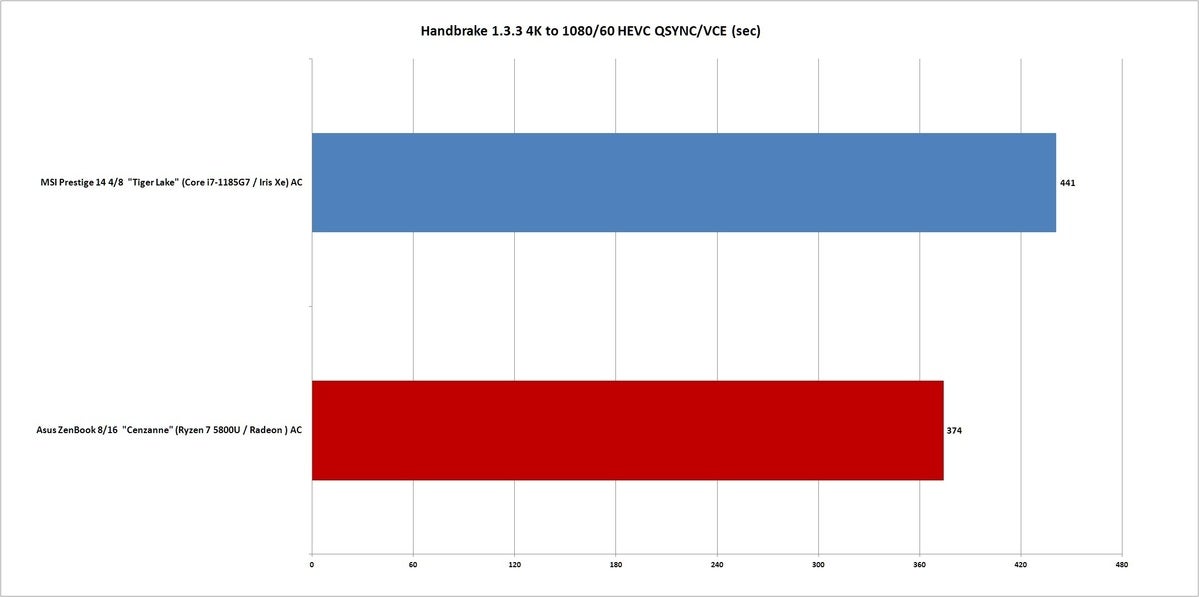 IDG
IDG Shorter bars indicate better performance.
Office and Adobe Application Performance
One argument that Intel has made (and we largely agree with) is all but people use very light laptops for doing very terrestrial things—not moving 3D modelling surgery encryption hours and hours of video.
Nothing says 'routine' look-alike the Microsoft Office chores that fill the solar day for many office drones. For that task, we used PCMark 10 Applications, which runs Microsoft Logos, Surpass, PowerPoint, and Edge through scripted tasks.
This is a test where the 11th-gen Intel CPU outshines AMD's previous Ryzen 7 4800U away a compelling 18 pct. With the improved IPC efficiency of the Ryzen 7 5800U we now find AMD slightly forwards—about 6 percent faster than the 11th gen Congress of Racial Equality i7-1185G7 nick. It's jolly much up a toss-up, but when you reckon past performance, this is a big win for AMD.
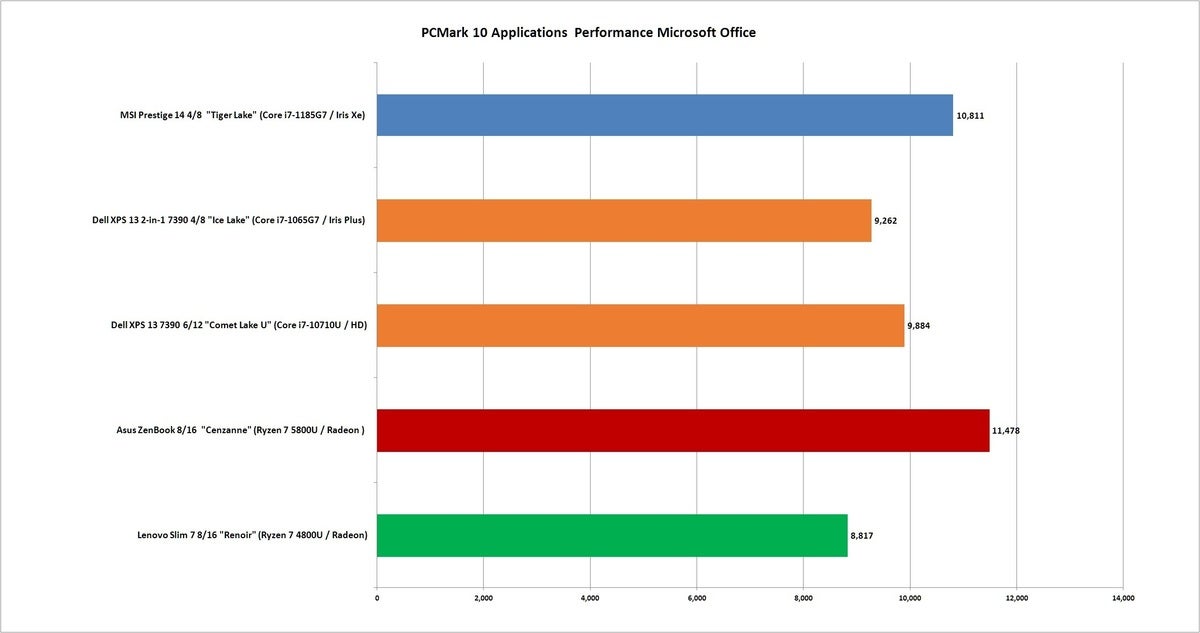 IDG
IDG Longer parallel bars indicate better performance.
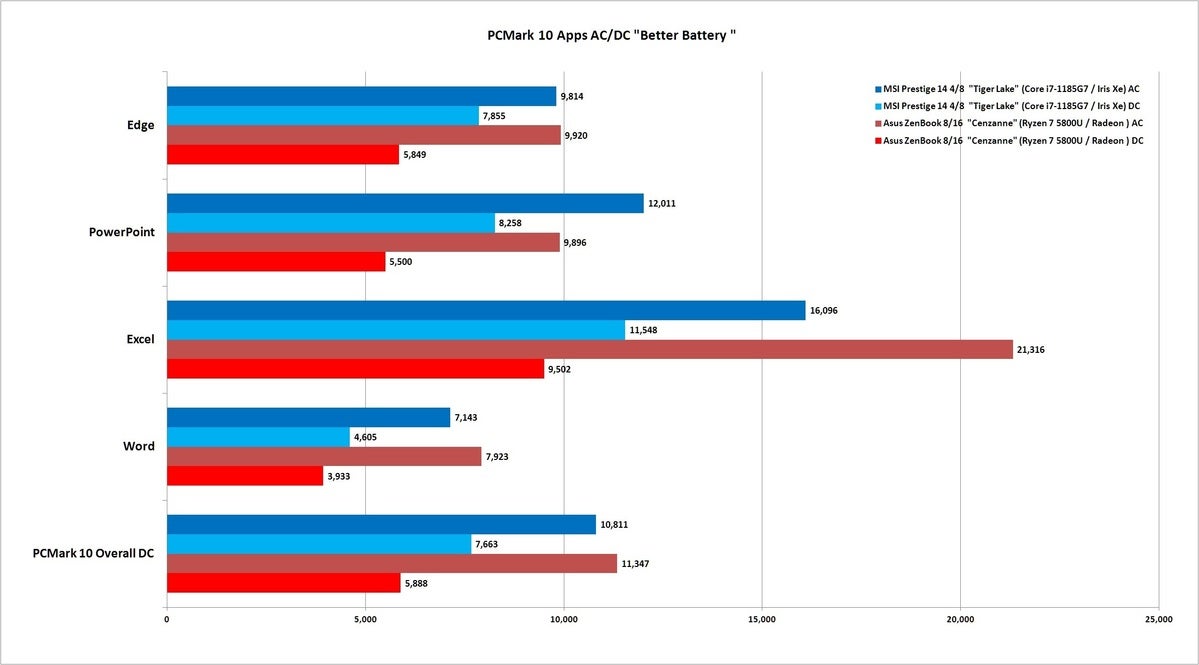
Before we go under on from boring old Office, we do want to touch on a problem Intel has interpreted strai to cite: Ryzen carrying out drops off the drop-off when the laptop's along battery. To test that claim, we re-ran PCMark 10 Applications with the two newest laptops plugged in, and so on battery with the Windows 10 power execution slider set to "better electric battery." The darker colors in the chart indicate the Alternating current performance, while the brighter, lighter colours indicating DC performance.
You rear end get wind the Core i7-1185G7, takes approximately a 30-percent haircut on bombardment, while the Ryzen 7 5800U takes a 48-percentage hit. There's more to be same happening this topic later on, but it's worth noting how the battery life of this Ryzen laptop suffers. So maybe Intel has a place here.
 IDG
IDG Longer bars argue better performance.
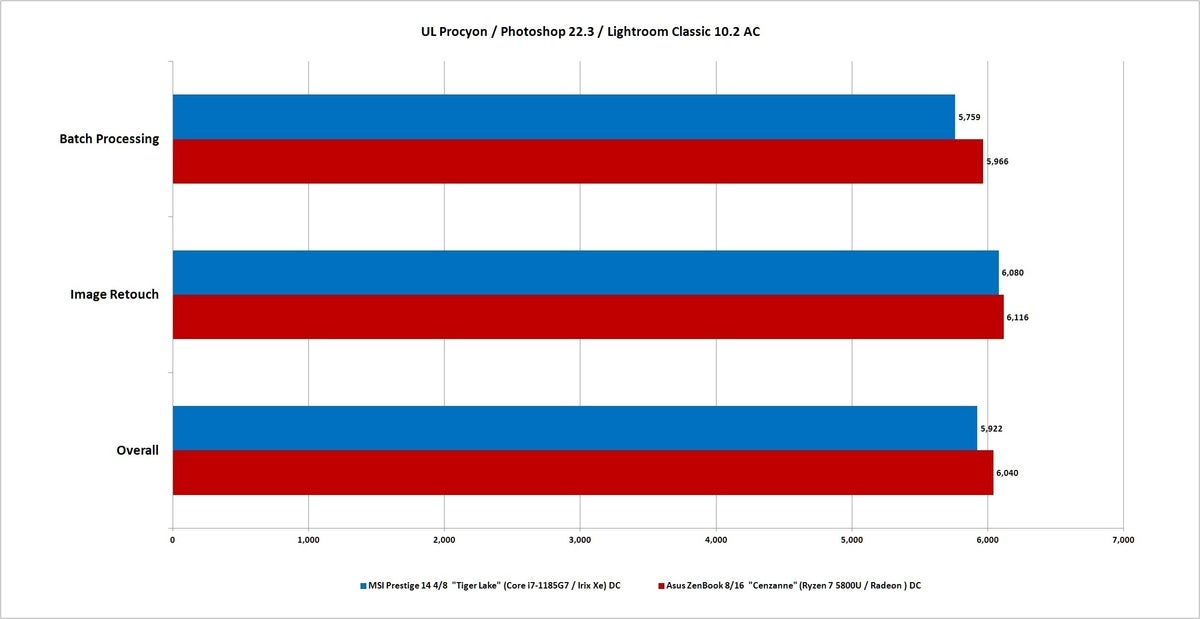
Moving on to the other favorite entourage of applications you actually enjoy victimization, we use UL Procyon to quantify performance of the Ryzen 7 5800U and Core i7-1185G7 in Adobe Photoshop 22.3, and Lightroom Classic 10.2. We lonesome have results for the top two laptops here because we wanted to use up the latest versions of Photoshop and Lightroom Classic available to us. We feel that's important, because processor and compiler optimizations matter.
You should know both applications are fierce, but they don't always function totally of the CPU cores. The GPU, as well as the ability to hold out high clocks, and vendor optimizations matter.
Although that red AMD bar is longer, we'Ra looking at generally a link present, with the overall score differing by only 2 percent.
If you were an Intel sports fan, you'd say scorn the octad cores in this Ryzen, the four-core Core i7 does just as well in that popular and strenuous task. If you were an AMD fan, you'd say that contempt the real high time speeds of the Core i7 and optimization that tend to favor Intel, it's basically a tie down. And you still get those supererogatory cores.
If you induce atomic number 102 skin in the game: You should au fon be intimate both are very skilled chips to have for Photoshop and Lightroom.
 IDG
IDG Yearner parallel bars indicate better functioning.
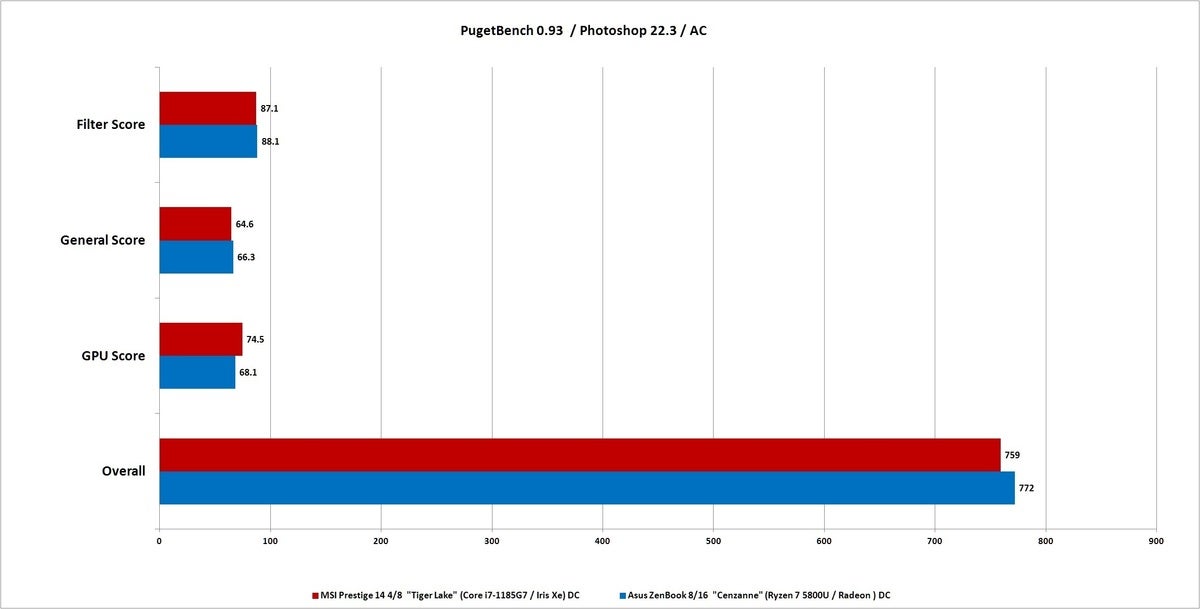
Peerless issue with a sprawling entourage much as Adobe Fictive Cloud is that different tasks may favor ane chip, while another may favor the other. To set about a second opinion on Photoshop carrying out, we also pass PugetBench 0.93, a test made away workstation maker Puget Systems to help advise its customers on what hardware to.
PugetBench also agrees . We see about a 2 percent separation between both chips. Basically, you can't lose with either again.
 IDG
IDG Longer bars indicate better carrying out.
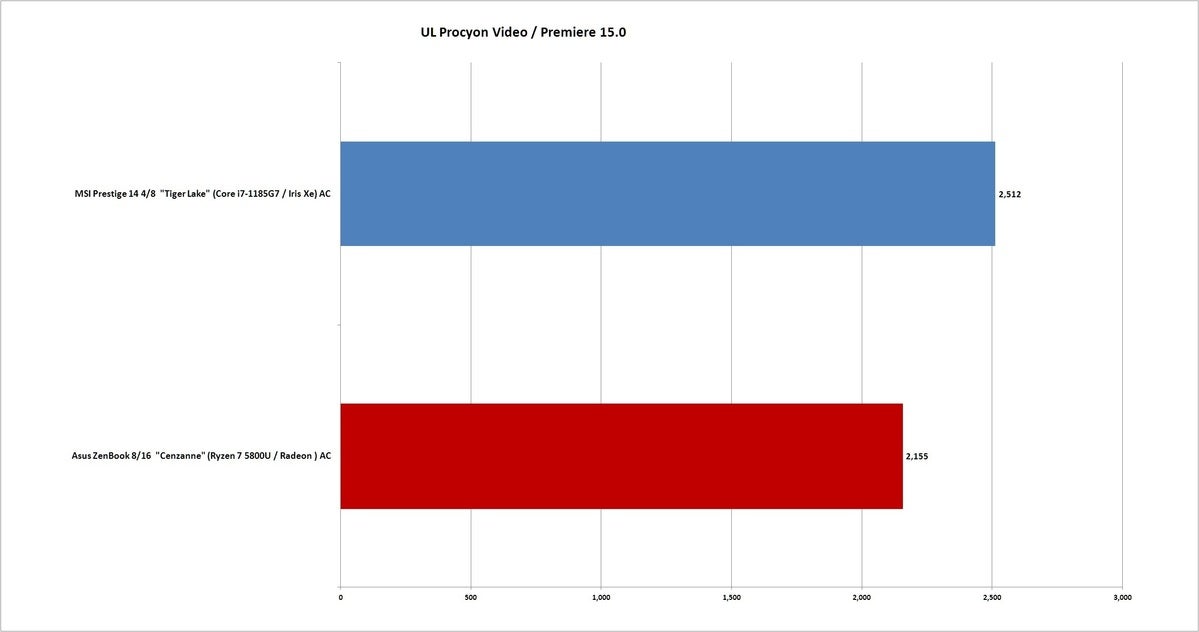
We'll close off our Adobe examination with UL Procyon Video test which measures a computer's public presentation using Adobe brick Premiere to add several effects to a video spell exportation IT several different shipway.
The winner? Intel's Core i7-1185G7 by a decent 16.5 percent.. Eastern Samoa we said above, these sprawling suites perform otherwise based happening what you actually do, and optimizations for Intel CPUs do so yield real benefits which you'rhenium sightedness here. So get ahead, at least, in Procyon Telecasting, goes to Panthera tigris Lake. We do know certain tasks in Premiere buttocks force it back to AMD just this one goes to Intel.
 IDG
IDG Longer bars indicate better performance.
We know you're here for gaming performance, so keep apart reading to construe with all the charts.
Play Performance
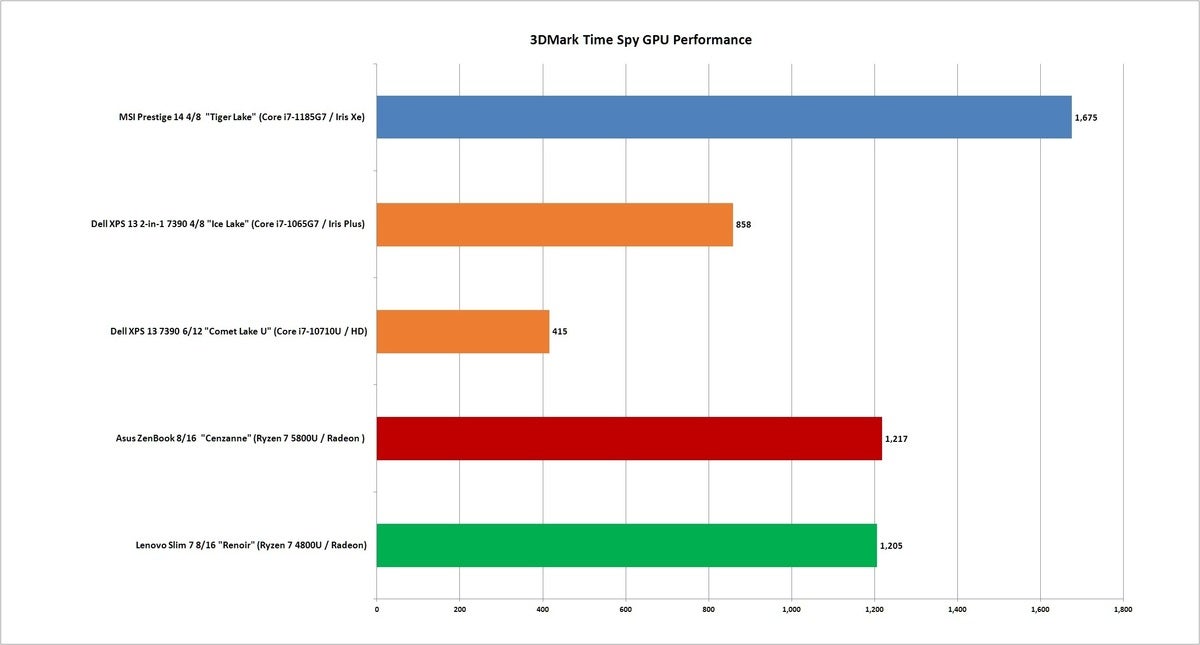
A lot of the performance tests so far have really seen the Ryzen 7 5800U romp or oppose Intel's best CPU. One field where the Core i7 gets pay back though is graphics operation. Most people see that spoken in gaming where you can see the Iris Xe in the Core i7-1185G7 romp complete over the Ryzen 7 5800U. In 3DMark Time Spy's GPU test which focuses only on graphics carrying into action, the Core i7 has a 37-percent advantage.
You can also see 3DMark leaves the Ryzen 7 5800U tied with the Ryzen 7 4800U. That's because for the just about part, AMD reuses the same Vega-based cores of the previous generation's chip.
 IDG
IDG Yearner parallel bars indicate better performance.
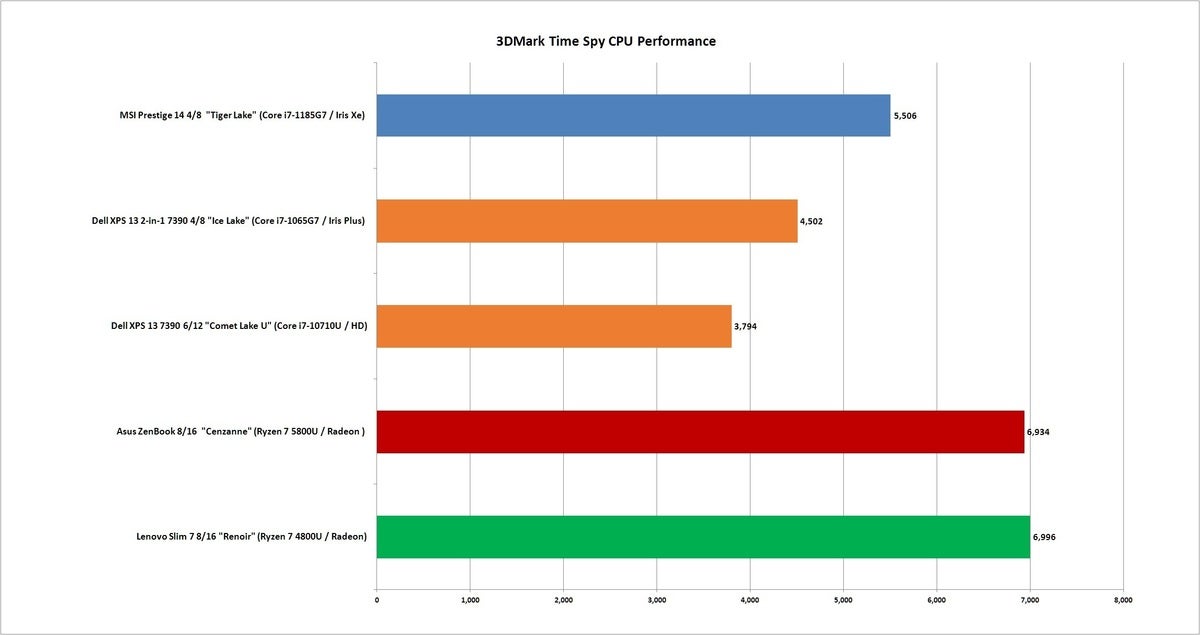
3DMark also includes a Central processing unit-concentrated gaming using a gaming physics mental test. Typically more cores matter hereplay and we see both Ryzen's do rather well. One thing we deficiency to point impermissible is the vast majority of games, especially those you'd gambol on integrated graphics ever actually use all those cores, so this particular quiz may not really match the real ,domain.
 IDG
IDG Thirster bars point better performance.
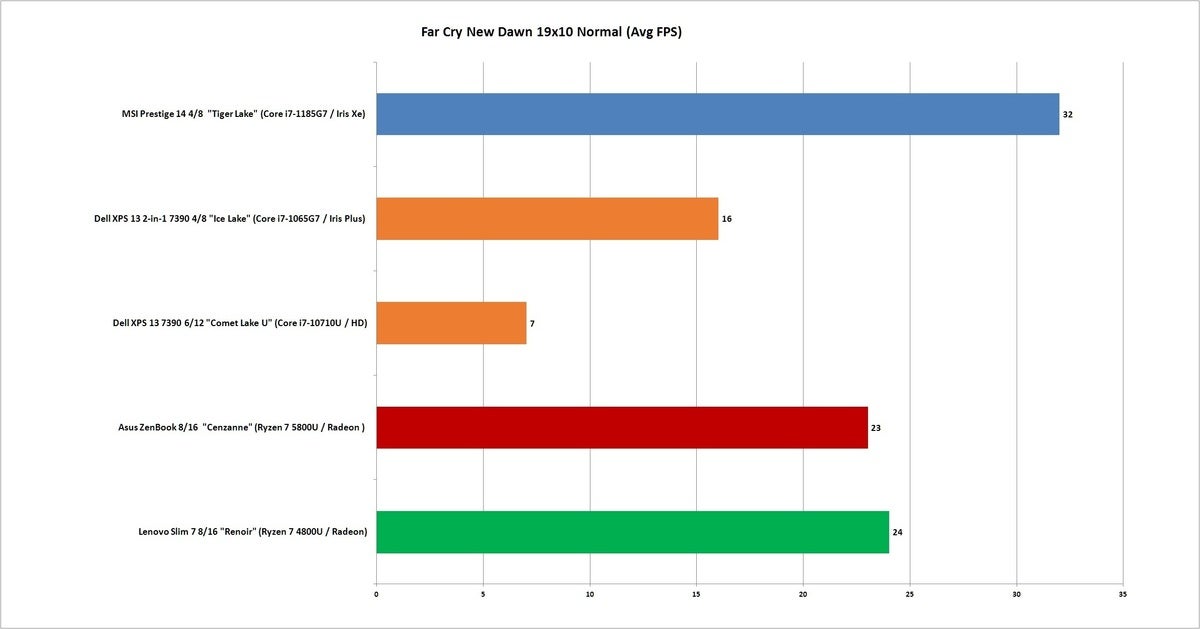
To go out how the chips plow actual gaming we first run Far Blazon out Fres Dawning set to 1920×1080 resolution and the "Normal" Preset. IT's some other sizeable win for Flag Xe in the Kernel i7-1185G7, with frame rates about 39 percent up of the new Ryzen 7 chip.
 IDG
IDG Longer parallel bars suggest better performance.
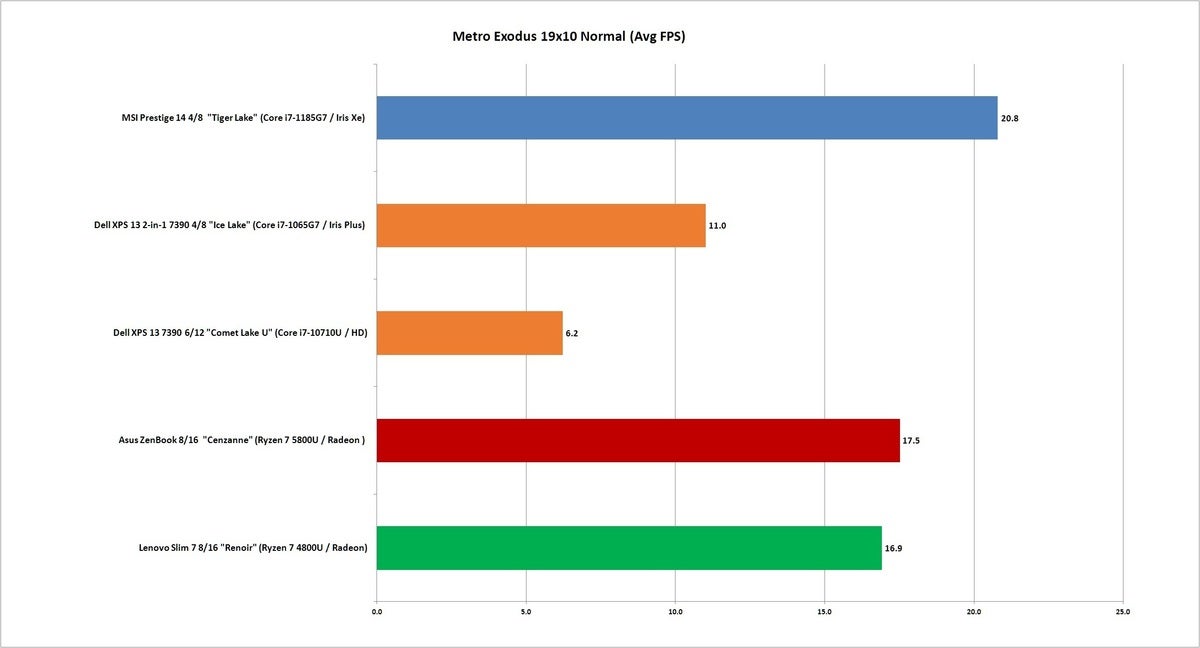
Next up is Metro Hejira place to 1920×1080 and exploitation the "Normal" preset. The Core i7 is again ahead by about by 19 percent. When you're looking at 20 fps vs. 17, it's non really that much to gasconade about. Still, Iris diaphragm Xe is no jest at.
 IDG
IDG Longer bars indicate finer performance.
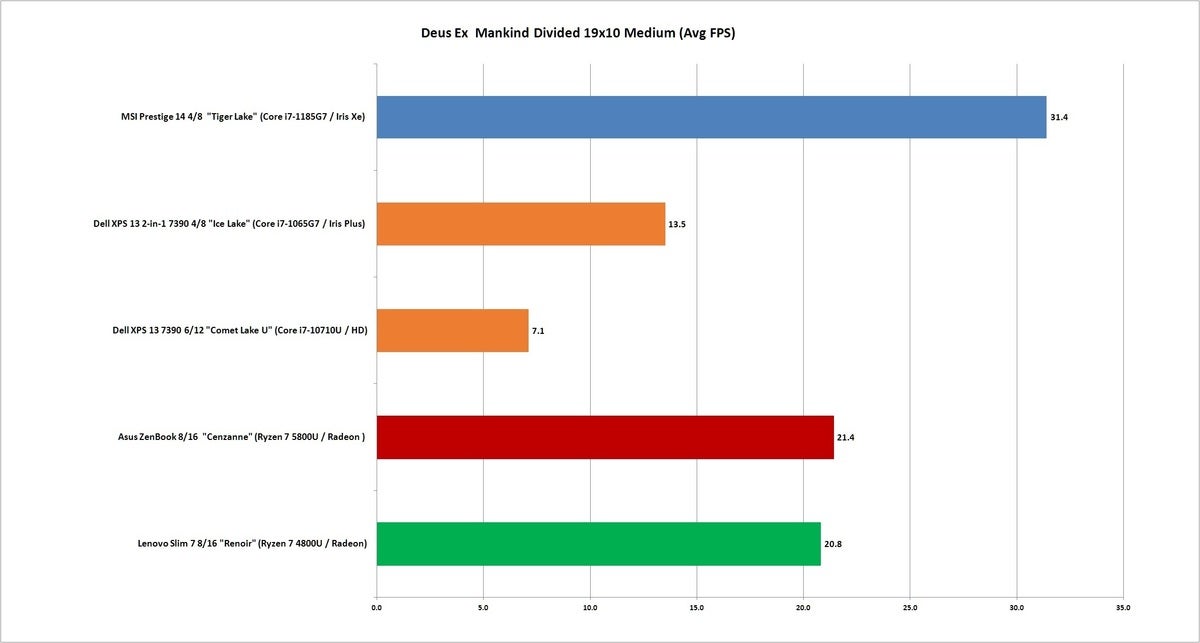
The CORE i7-1185G7 and Iris Atomic number 54 chalks up a gracious sizable advantage in Deus Unstylish: Humankind Divided set to 1920×1080 and its Medium preset. Here, the Intel chip is running active 47 percent faster than the Vega graphics in the Ryzen 7 5800U.
 IDG
IDG Thirster bars indicate punter execution.
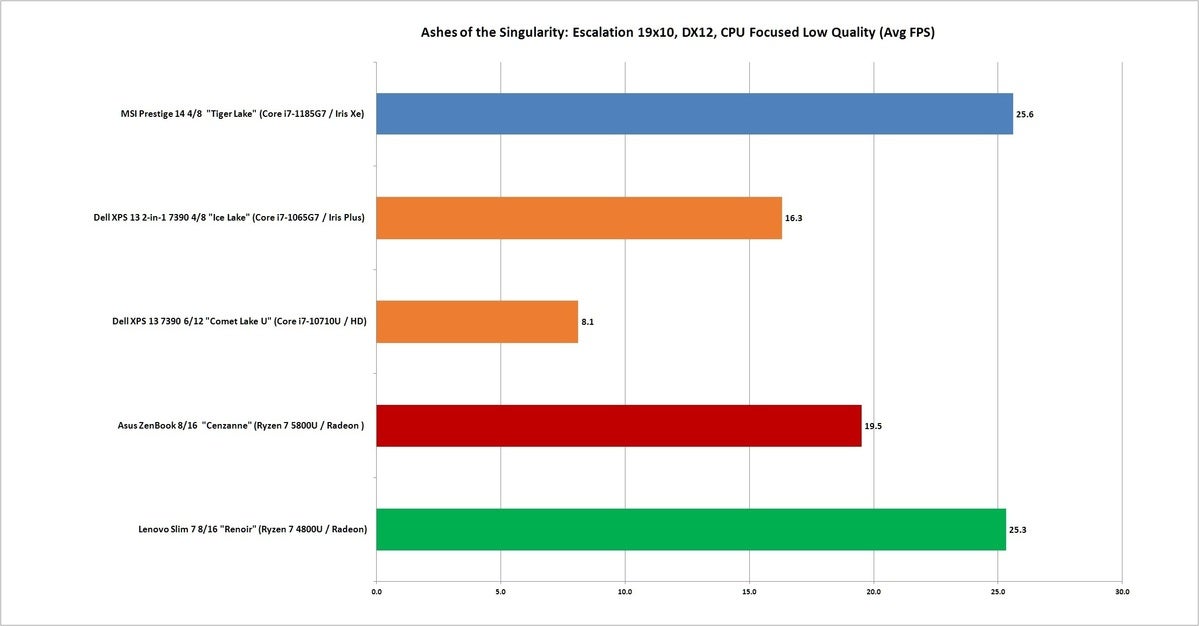
Most games tend non to utilize really many CPU cores, but Ashes of the Singularity: Escalation is another matter. While IT won't use 64 cores for gaming, more cores generally helps. We ran Ashes at 1920×1080 resolution exploitation the low-prime presetWe picked the CPU-focused predetermined which uses more game units on the screen.
The Core i7 is still the winner, but the older Ryzen 7 4800U really is the CPU that comes the closest. Queerly, the Ryzen 7 5800U just does not set well here which is a bit puzzling to us. We'll drive other looking at at this, but it Crataegus oxycantha be better thermals of the Lenovo Small 7 vs. the Asus ZenBook are at play here equally expected both to be very similar.
 IDG
IDG Longer parallel bars indicate better performance.
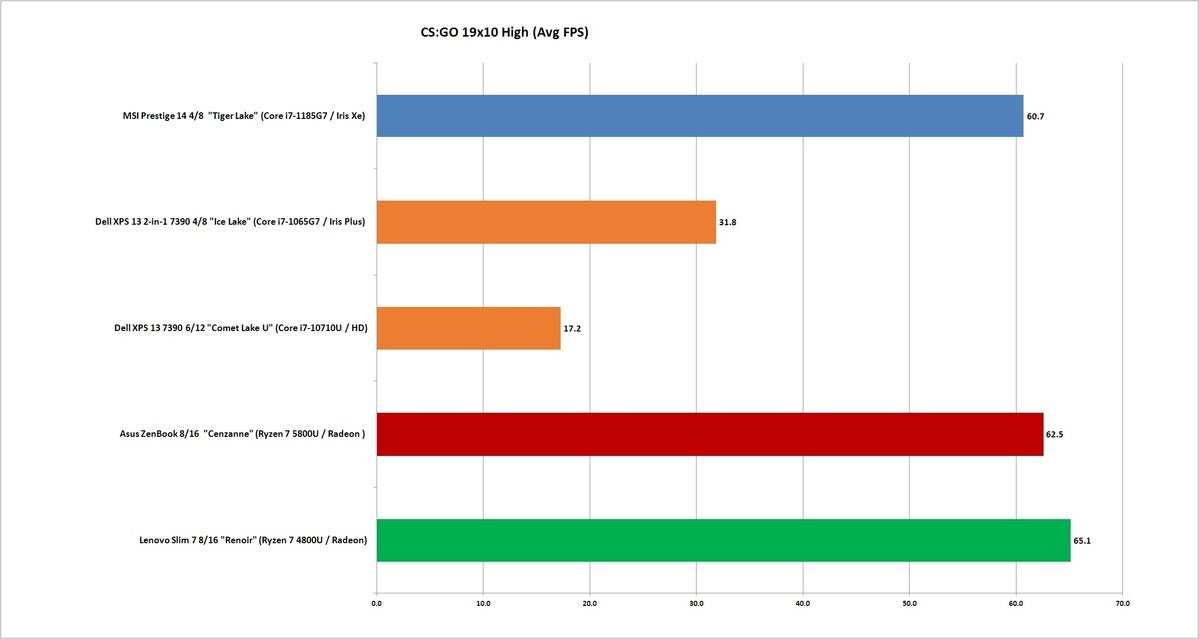
Our last gaming mental test uses the popular Retort Strike: Global Operations set to 1920×1080 and the high planned. The game has tended to favor AMD CPUs lately and Here we get a line it's mostly a tie with the Ryzen 7 5800U only 3 percent faster. The elderly Ryzen 7 4800U actually has around a 7 percent advantage which again makes U.S. think the thermals of the Asus ZenBook could live responsible.
The good newsworthiness is we have trinity laptops with integrated graphics that can wholly hit that wizard 60-fps frame rate in a halting you'd actually want to looseness.
 IDG
IDG Longer bars bespeak better performance.
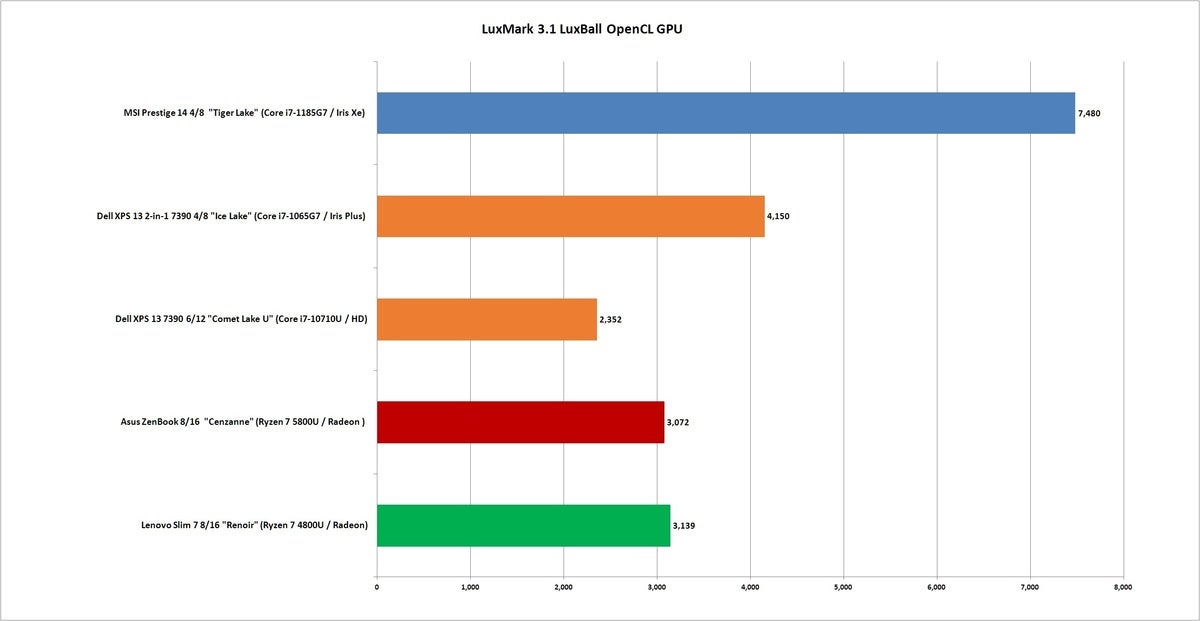
We'll let in results from LuxMark 3.1 keep going each laptop's GPU. The big winner for OpenCL performance here is the Substance i7-1185G7.
 IDG
IDG Longer bars indicate advisable execution.
AI Performance
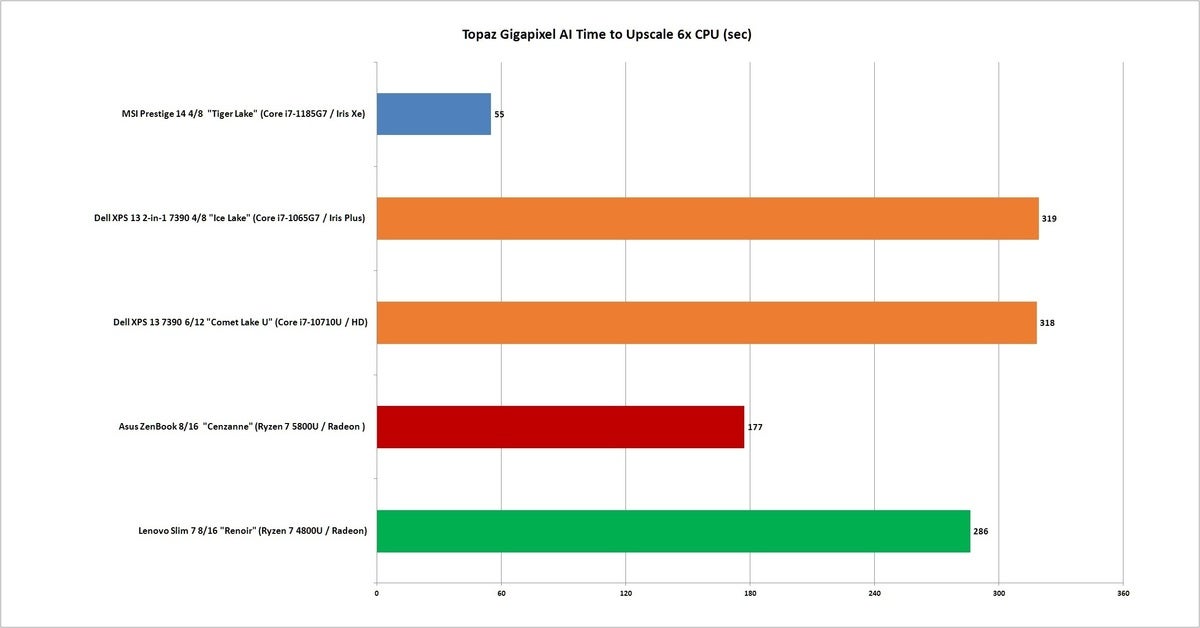
We'll wrap up our CPU testing in the brave bran-new world of AI performance. Initial up, we use Topaz Lab's Gigapixel AI to gain the resolving of a picture away 6X using the CPU rather than the GPU for the undertaking. Gigapixel AI can take advantage of Intel's DL Hike. which helps the Core i7-1185G7 finish the chore about 68 percent faster than the Ryzen 7 5800U. The new Ryzen should tap itself along the back for its performance, which finishes the conversion in 38 per centum less time than the older Ryzen 7 4800U.
 IDG
IDG Shorter bars indicate better performance.
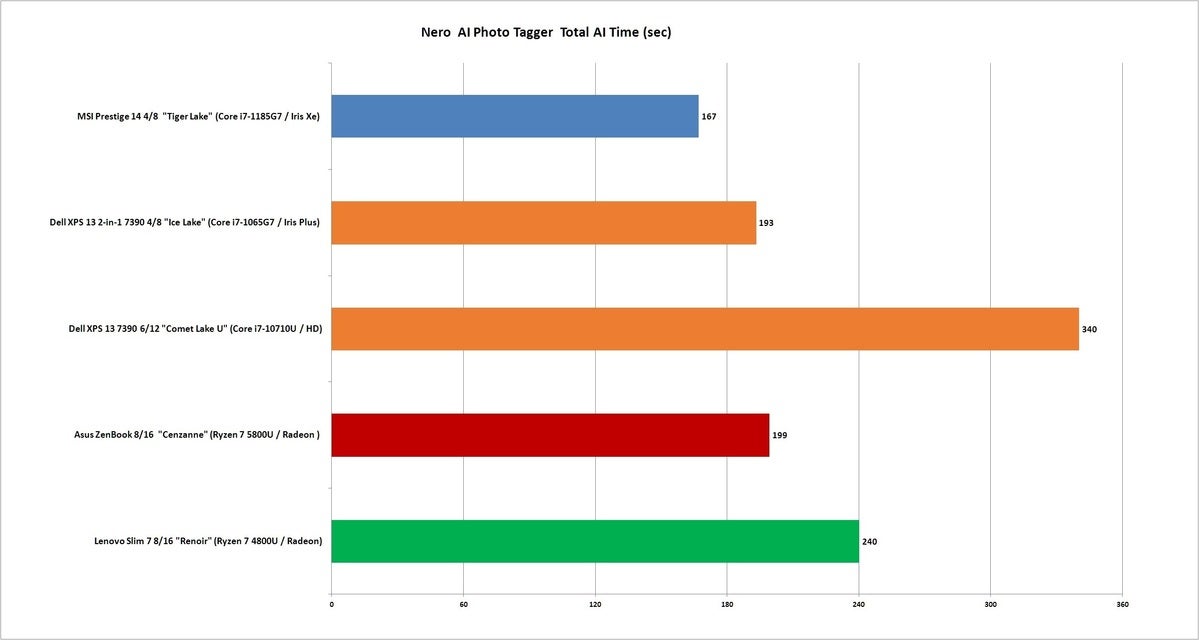
Much of the consumer applications for AI today is in imaging, indeed we also run the laptops direct Nero's AI Photo Tagging program. The application uses AI to analyze and tag photos for you. We tasked each laptop with analyzing 4,200 photos exploitation AI Photo Tagger. The total clock time each laptop washed-out analyzing the photos using AI is presented.
Spell AI carrying into action is even so fairly niche, borrowing is trending up. Mostly we find that a faster GPU and Intel's newest cores incline to run the tabular array present.
 IDG
IDG Yearner bars indicate better performance.
Battery life-time
If comparison performance across laptops can be dangerous, comparing battery life on those CPUs is downright impossible. Every laptop computer is built differently, and everything from the quiz to the display settings to the performance settings can muddy the amniotic fluid.
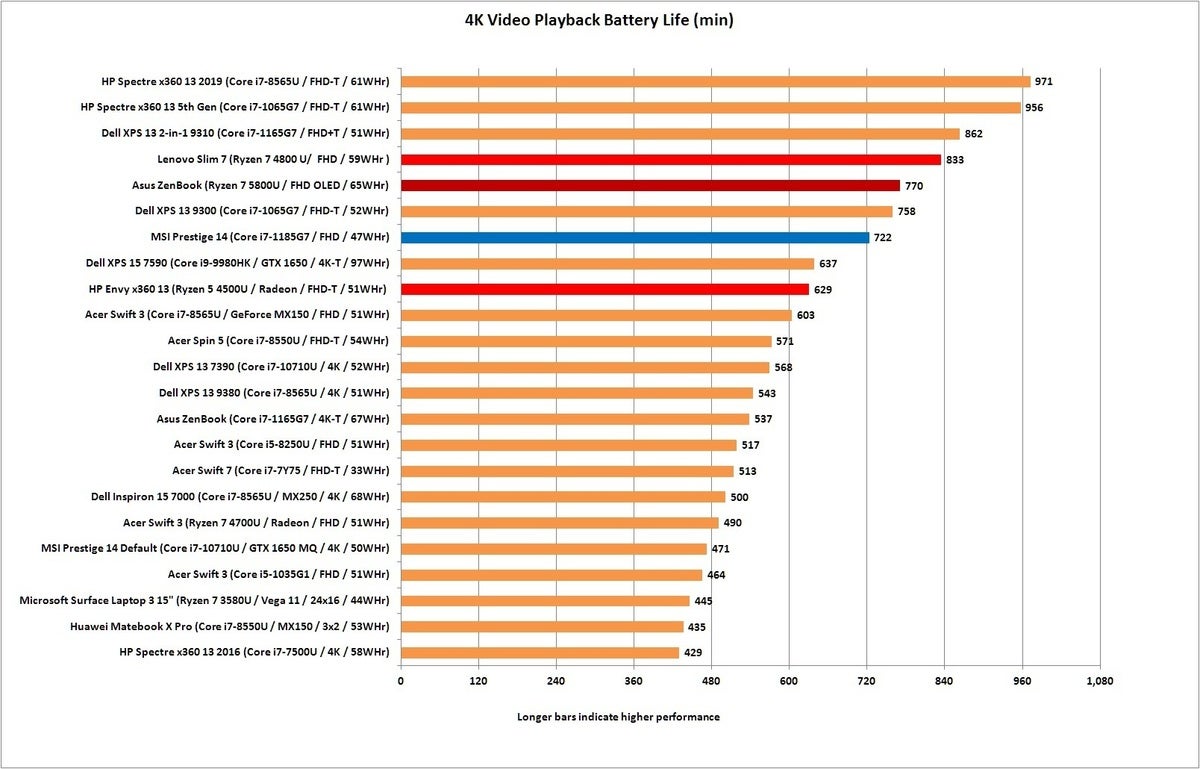
Still, the main question you deficiency to know is whether Ryzen 7 5800U is a top executive hog. We run our standard 4K Tears of Steel video with the laptop computer set to aeroplane mode. We connect earbuds at 50-percent volume (to reduce the laptop computer speaker power use of goods and services) and at a relatively bright 250 nits to 260 nits. We also use Microsoft's Movies & TV participant, which is among the near efficient available.
The main takeout is that battery aliveness for AMD's newest Ryzen 7 5800U can be bad darn good, but it largely depends along the private laptop. The Asus ZenBook, with its OLED and rhetorical 65-watt-hr battery, basically gave us in excess of 12 of hours of video rundown clock time.
 IDG
IDG Longer parallel bars indicate better performance.
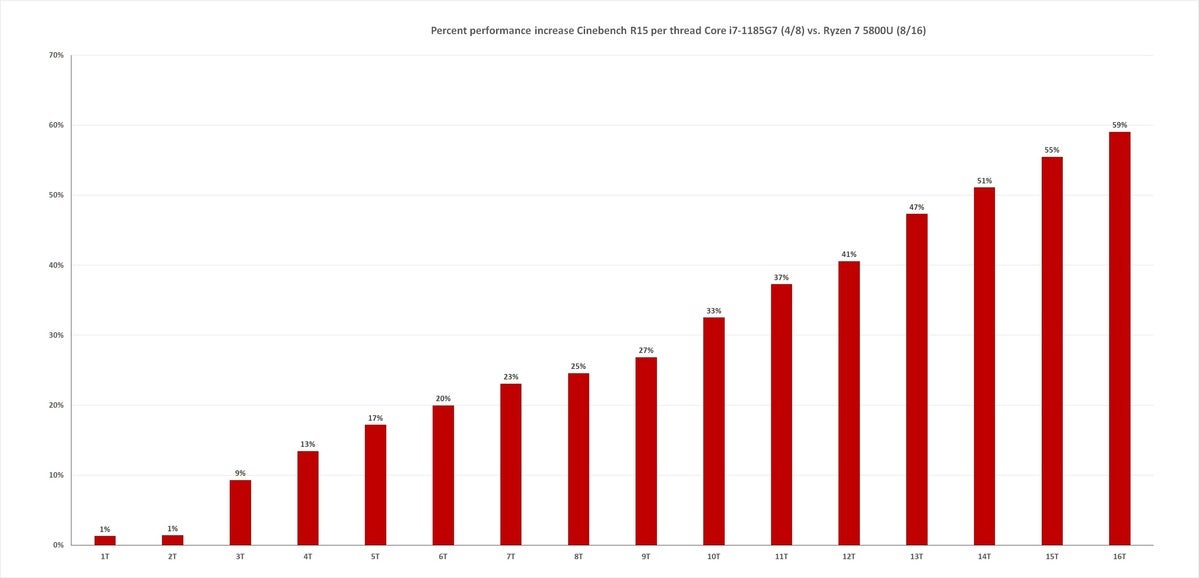
We'll close together all of this out by looking at the strengths of the Ryzen 7 5800U per thread. This helps USA imag generally how fast the CPU can be contingent on how heavy of a task is thrown at it. To serve that, we run Cinebench R15 victimisation an increasing numbers of threads, clear to the maximal amount of threads the CPU has. The chart shows the percent step-up against the Core i7-1185G7.
No surprise, the novel Ryzen 7 5800U just rocks the Tiger Lake give all but the lightly threaded tasks. It's pretty straight to see how fast the Ryzen 7 5800U is on right side where you wont all those CPU cores and threads, patc Core i7-1185G7 holds its own on the very left pull of the chart.
 IDG
IDG Longer bars betoken bettor performance.
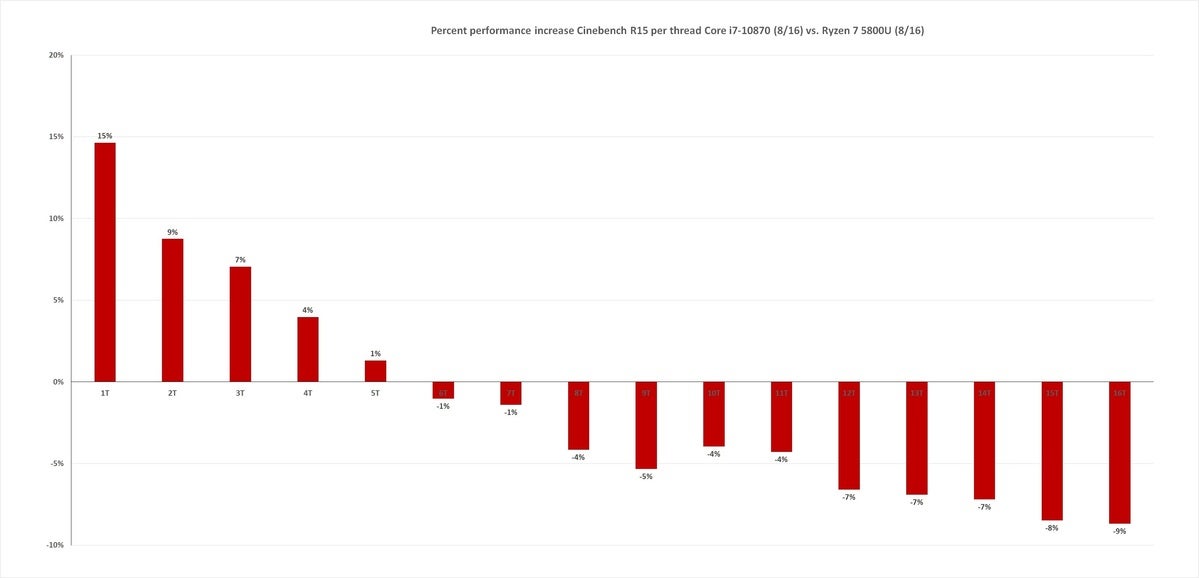
Perhaps flatbottomed more impressive is to take the Ryzen 7 5800U and comparability it to Intel's current 8-core 10th gen Core i7-10870H contribute the Gigabyte Aorus 17G . Different the 11th-gen Core i7-1185G7 chip that's built on a 10nm FinFET process, the 10th gen is reinforced on Intel's elderly 14nm sue, which runs hotter. It likewise uses Intel's older Comet Lake cores, which simply aren't as efficient equally Tiger Lake's "Willow Cove" cores.
While the 11th gen Core i7-1185G7 actually does fairly well along the left position of that chart, the 10th gen Core i7-10870H is simply underwater the whole time. The Core i7-10870H doesn't actually clear an upper pass until the multi-core load gets heavy sufficient to overwhelm the temperature reduction of the tiny Asus laptop. This is particularly majestic because the Aorus 17G is a big, thick 17-inch gaming laptop that weighs 6 pounds vs. the 2.6- pound Asus. That's just a super wow.
 IDG
IDG Yearner parallel bars indicate better performance.
Ending
As expected, Intel was never passing to be the push-over in slim-and-light laptops the way it was in gaming laptops and desktops for Ryzen 5000. While we'd have a rough sledding recommending an Intel Processor finished an AMD CPU in desktops (except you can really buy the Intel CPUs), in the mobile place we're far more hesitant to declare a "success."
Instead, it much comes down to how you function your laptop computer and what CPUs is the best for your needs.
We definitely declare the Ryzen 5000 the winner for anyone who necessarily more cores. That a good deal is identified, as the math says eight cores is more than four cores.
For miscellaneous application employ and image editing, Ryzen has a slight edge, merely we'd claim it mostly a cast aside-up. The argument you'd make for Ryzen, is you can have awesome covering performance—and you tail more cores too! That's pretty compelling and would push most to Ryzen.
The 11th-gen Tiger Lake chip, however, gets the nod for gaming performance. While the Ryzen 5000 isn't bad, the Iris Xe art clearly put it leading.
If there were a "success" IT would be consumers, because you can now pick the best processor for what you doh on your PC rather than simply attractive what Intel has to offer and that's it.
Correction: A previous version of this story inadvertently reversed results for the Ryzen 7 4800U and Ryzen 7 5800U in Cinebench R20. PCWorld regrets the error.

Source: https://www.pcworld.com/article/394451/amd-ryzen-5800u-review-is-it-better-than-intels-11th-gen-mobile-chip.html
Posted by: schroederheyedidecle71.blogspot.com
0 Response to "AMD Ryzen 5800U review: Is it better than Intel's 11th-gen mobile CPU? - schroederheyedidecle71"
Post a Comment