

Can You Code For Replacement Of Nail And Eponychial Fold After Nail Bed Repair?
Editor's Note: "Consult Corner" addresses a consult commonly encountered by an on-call resident. The column begins with the reason and assesses questions that might get through a resident's mind equally he or she heads to the emergency department to encounter the patient. Key aspects of the history and physical are discussed, as well as additional testing that should be obtained. Finally, a review of the decision-making process will present possible management strategies, all of which are synthesized into the context of an actual example.
MESSAGE ON YOUR PAGER: LACERATION THROUGH NAIL BED, Think Please.
Information technology'southward midnight, yous're covering hand call in the pediatric E.D. - and your pager goes off. The bulletin reads:
"4-yr-onetime daughter jammed finger in door and has a laceration through the boom bed"
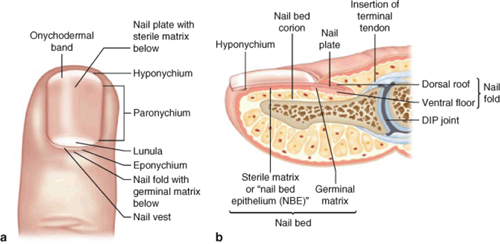
The eponychium refers to the dorsal nail fold and the skin proximal to the nail, while the hyponychium refers to the palmar skin distal to the nail. The paronychium refers to the skin around the lateral boom folds.
On the blast itself, the lunula is the white, semilunar office of the proximal portion of the smash. The nail bed lies direct underneath the blast plate. The nail bed is composed of the germinal matrix and the sterile matrix. Proximal to the lunula is the germinal matrix, which is responsible for nail growth and is located from 7-8 mm under the eponychium to the border of the lunula. Nails grow very slowly, at a charge per unit of 0.i mm/solar day, so it will have several months for the blast to regrow. Distal to the germinal matrix is the sterile matrix which is responsible for adherence of the boom to the blast bed.
History
The timing and mechanism of injury is important to document. As with whatsoever mitt injury, hand authorization and hobbies and/or occupation is important to notation, if relevant, since many of these patients tend to be younger kids. Always ask about tetanus vaccination. If that's non upwards-to-date, they should receive a tetanus booster.
Examination
Oftentimes the nail has already been avulsed, just if non, nail-bed lacerations tin be associated with subungual hematomas. If the subungual hematoma involves greater than 50 percentage of the blast, the boom should be removed and the nail bed should be examined for the presence of a nail-bed laceration. Other things to annotation are degree of contamination and exposure of bone. All patients should have a complete hand exam.
It's important to obtain an X-ray to rule out any fractures. Nail-bed injuries are commonly associated with tuft fracture of distal phalanx. Repairing the nail-bed laceration should reduce the tuft fracture.
To Repair a Nail Bed Laceration
Lidocaine (digital block)
25-G needle, syringe
Digital tourniquet (cut off slice from glove finger)
Normal saline
Betadine
Iris scissors, periosteal elevator
vi-0 fast gut or chromic suture
Stent for boom fold (part of suture packet if nail is unsuitable)
Antibiotic ointment
Procedure
You perform a digital block by injecting 1-2ml of lidocaine at the volar aspect of the proximal flexion crease of the finger (in children, always remember to verify the maximum amount of local anesthetic appropriate for the child's weight, to ensure that you do not administer more than than id required). Depending on the age and cooperation of the child, you may need additional forms of sedation. Give the local anesthetic at least 5 minutes to take effect. While yous are waiting, you tin can fix-up the rest of your supplies.
Copiously irrigate the wound with at to the lowest degree 1 liter of irrigation. Apply a finger tourniquet to the base of the digit to help in hemostasis. Prep the hand with Betadine, and towel appropriately. Assess the blast bed.
Repair the nail-bed laceration with dissolvable sutures (fast gut or chromic). Repair any other associated lacerations on the finger which can exist done with nonabsorbable sutures for any lacerations outside of the blast bed, if the child will tolerate removal in clinic setting. If non, utilize absorbable sutures.
If the nail's however in place, use Iris pair of scissors or a periosteal elevator to spread at the hyponychium. Advance proximally until the instrument reaches the boom fold - and then the nail should exist able to be easily removed with a hemostat or forceps.
It'south important to stent-open the eponychial fold to prevent it from scarring downwardly, which would impair proper regrowth of the blast. To fashion a stent for the eponychial fold, you lot tin can utilize the foil from a suture pack or xeroform; cut into the shape of a boom; and constrict it under the fold. If the parents brought the nail in, that tin be used every bit a stent subsequently being properly done in Betadine. The stent tin exist secured with a chromic suture in horizontal mattress fashion, with the knot on the eponychium, and then that the boom is pulled under the fold by the suture. One additional, simple suture can be placed through the stent at the hyponychium to preclude the stent from flipping off of the nail bed.
Dressing
Bacitracin, Xeroform and a gauze wrap are commonly used. Beware that Xeroform can stick to the nail bed which tin be very painful to remove in clinic later the dressing has been in place for a few days. Using a nonstick dressing over the Bacitracin and the laceration (such as Telfa) will help with dressing removal. For younger children, it'due south prudent to place a soft, bulky gauze dressing with a calorie-free Ace cast wrap on the extremity to prevent additional trauma to the digit. If there is an associated distal tuft fracture, identify finger in an extension splint. The distal interphalangeal joint should be splinted in extension. A nail-bed laceration with a tuft fracture is technically an open fracture, so these patients should exist discharged on oral antibiotics too. Follow-up in clinic in one week for a wound check.

Can You Code For Replacement Of Nail And Eponychial Fold After Nail Bed Repair?,
Source: https://www.plasticsurgery.org/for-medical-professionals/publications/plastic-surgery-resident/news/consult-corner-laceration-through-the-nail-bed
Posted by: schroederheyedidecle71.blogspot.com
0 Response to "Can You Code For Replacement Of Nail And Eponychial Fold After Nail Bed Repair?"
Post a Comment